Heterotermes aureus, the native desert subterranean termite, nests up to 8 feet deep beneath the desert floor to endure summer ground temperatures exceeding 115 degrees Fahrenheit. In Maricopa County, these colonies…
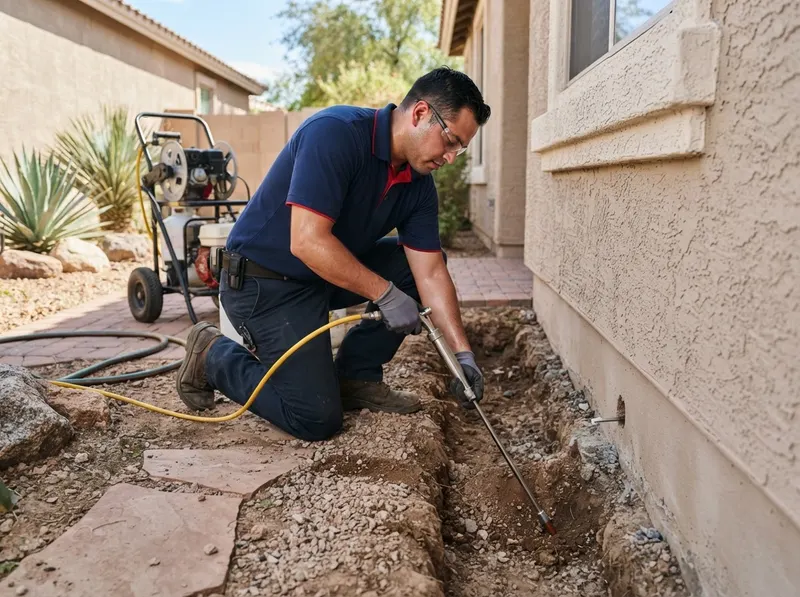
Heterotermes aureus, the native desert subterranean termite, nests up to 8 feet deep beneath the desert floor to endure summer ground temperatures exceeding 115 degrees Fahrenheit. In Maricopa County, these colonies bypass standard exterior barriers through subterranean network lines, constructing earthen shelter tubes over stem walls and entering wall cavities through expansion joints or interior bath traps. Liquid trenching creates an unbroken vertical barrier by excavating a 6-inch-wide by 6-inch-deep trench directly against the stem wall, saturating the backfill with a non-repellent termiticide at a label rate of 4 gallons per 10 linear feet. When foraging workers transit the treated zone, they unknowingly ingest and transfer the active ingredient throughout the subterranean colony through grooming and food sharing.
Slab-on-grade homes in Marshall Ranch, Ranch de Concepcion, and Bellair present structural junctions that soil trenching alone cannot protect. Where concrete patios, walkways, or garage slabs butt directly against the foundation, void injection requires drilling 1/2-inch access ports spaced 12 inches apart along the expansion joint. A low-pressure sub-slab rod delivers the liquid termiticide directly into the coarse aggregate layer below the slab. Hollow CMU block walls found throughout the Catlin Court Historic District and Sahuaro District require vertical block-void injection, saturating the interior voids where mud tubes frequently rise unnoticed behind finished drywall.
For suburban parcels bordering natural desert washes near Thunderbird Conservation Park or older flood-irrigated citrus acreage in Manistee Ranch and Arrowhead Ranch, moisture gradients elevate termite foraging pressure. Choosing liquid trenching and void injection provides immediate continuous structural isolation, unlike perimeter bait stations which depend on seasonal foraging discovery over a 6 to 18 month window. The structural trade-off requires visible 1/2-inch drill holes through exterior hardscapes, which are sealed flush with matching hydraulic cement patches upon chemical application.
Every job gets a firm, written price after a free on-site visit.
Tell us about your subterranean termite liquid trenching & void injection job in Glendale and we'll send a clear, written quote, usually the same day.
 Veltrix Insect Services